No. 450 SQN 85th Anniversary of Formation & Departure for WWII Service [1941]
PILOTS

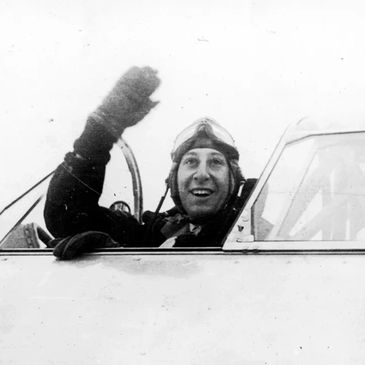
F/Sgt Evan Walter 'Jimmy' JAMES
F/LT Reginald Victor KIERATH MID
F/LT Reginald Victor KIERATH MID
Service: Royal Air Force
Service Number: 1653092
Mustering: Pilot
Born: 27 April 1923, Wales
Enlisted:
Next of Kin: JAMES, Dan
POW: Stalag Luft 7 at Bankau Poland — 1944-1945
Rank: Flight Sergeant
______________________________
The following is a reproduction of
'Jimmy's Story'—
FROM FIRE TO FAITH AND FREEDOM
The story of Second World War
Service: Royal Air Force
Service Number: 1653092
Mustering: Pilot
Born: 27 April 1923, Wales
Enlisted:
Next of Kin: JAMES, Dan
POW: Stalag Luft 7 at Bankau Poland — 1944-1945
Rank: Flight Sergeant
______________________________
The following is a reproduction of
'Jimmy's Story'—
FROM FIRE TO FAITH AND FREEDOM
The story of Second World War fighter pilot Jimmy James
by permission of the author Richard Ingham
Book design and image enhancement by
Martin Teviotdale
In April of 2018 when this true story was being compiled, its central character, Jimmy James, was celebrating his 95th birthday.
For Jimmy it was a time of happiness and reflection, of recollection and thanks. Jimmy had a loving wife and a devoted family.
As with all birthdays there were gifts and thanks to be expressed. But through the happiness there was one gift which couldn't be wrapped. It was one which Jimmy treasured and for which he was happy to give thanks. It was the gift of life.
That life had so nearly been snatched away from him over seven decades before when he was a Second World War pilot. His Kittyhawk single-seater fighter had been hit by enemy fire and he struggled to get out of the cockpit. He survived but he felt then, and still feels today, that he was not alone in the cockpit. He still speaks of that hand of God and being saved for a purpose.
That Christian belief, that faith, has never left Jimmy. He still gives thanks and is a valued and respected member of his local church. He is also much liked by the school-children he is happy to visit and to talk to about his experiences and, of course, by his family who recognise they would not be there were it not for what Psalm 46 calls "God's very present help in trouble".
For as long as he can remember Jimmy James has been fascinated and intrigued by aeroplanes and the thought of flying.
He can recall the feeling of wonder and excitement he experienced as he watched the light planes taking off with the lucky people who could afford the 2/6d (12 1/2p) or 5s (25p) cost of the pleasure flights taking off from near his family home in Llangynwyd, Bridgend, Wales. His family couldn't afford the flights but Jimmy was never to lose that fascination with flying and aircraft.
And for this young boy with his head in the clouds that fascination was nearly to cost him his life about a decade later as a Second World War fighter pilot.
His single-seater 1360hp Kittyhawk had been hit by enemy ground fire. He knew he had to get out but was too low. He opened the throttle to gain more height but that increase in power had a devastating effect. The engine burst into flames which blew back over the cockpit.

F/LT Reginald Victor KIERATH MID
F/LT Reginald Victor KIERATH MID
F/LT Reginald Victor KIERATH MID
Service: Royal Australian Air Force
Service Number: 402364
Mustering: Pilot
Born: 20 February 1915—Narromine, NSW
Deceased: 28 March 1944 — Brux (Most) Czech Republic (at the hands of the Gestapo)
Enlisted: 1940
Enlistment Place: Sydney, NSW
Posting on Death: No. 450 Squadron RAAF
Rank: Flight Lieutenant
Posthumous Award: Mention in Des
Service: Royal Australian Air Force
Service Number: 402364
Mustering: Pilot
Born: 20 February 1915—Narromine, NSW
Deceased: 28 March 1944 — Brux (Most) Czech Republic (at the hands of the Gestapo)
Enlisted: 1940
Enlistment Place: Sydney, NSW
Posting on Death: No. 450 Squadron RAAF
Rank: Flight Lieutenant
Posthumous Award: Mention in Despatches (MID) awarded on 8 June 1944
_____________________________
'Rusty's Story'—
In November 1940 Reginald 'Rusty' Kierath embarked at Sydney for overseas service, proceeding to Rhodesia to begin his pilot training under the Empire Air Training Scheme. 'Rusty' began his pilot training in December 1940 gaining his 'wings' in April 1941.
In June 1941 he arrived in the Middle East and was posted to No.71 Operational Training Unit at Ismailia, Egypt where he trained on Hawker Hurricane aircraft. In July 1941 due to inexperience with the aircraft he ditched into Lake Timsah (on the Suez Canal), and suffered scull and facial injuries which were not serious.
In August 1941, Sgt. Kierath received his first combat posting to No.33 Squadron RAF. He was lucky to escape death on two occasions in September 1941, when on 7 September he was ground strafed by enemy fighters while taking off from Sidi Haneish and his Hurricane burnt out.
On 9 September, while on a fleet patrol, the squadron was bounced by Bf 109s and his aircraft was holed in the port wing by a cannon shell, wounding him with shrapnel.
In December 1941 he was posted to No.450 Squadron RAAF which was in the process of forming up as a new fighter squadron. Although he was operationally tired, F/Sgt. 'Rusty' Kierath was one of a number of experienced Australian pilots alongside pilots with no combat experience, to support the Commanding Officer, SL Steege, to prepare the squadron as a fighting unit. Having only flown Hurricane fighters on operations 'Rusty' was now required to convert to the new P-40 Kittyhawk which was being introduced to desert operations.
F/Sgt. Kierath was on probation for commissioning as an officer from January 1942. This probation was extended for his first tour with 450 Squadron RAAF. In April 1942 he was released as an airman and granted a commission as a Pilot Officer, effective May 1942.
After completing his first tour of operations with 450 Squadron on 24 May 1942, 'Rusty' was posted out for a 'rest', returning to Rhodesia and training new pilots in Harvards and Tiger Moths.
In 1943 he was promoted to Flying Office, which was backdated to July 1942.
On 15 April 1943, Pilot Officer Kierath rejoined 450 Squadron at El Djem, Tunisia for his second tour of operations. This was to be short lived, however, as on 23 April, while on a 239 Wing sweep to Cap Bon, his Kittyhawk was hit by anti-aircraft fire, damaging his engine. He was forced to bale out over the Mediterranean Sea and was rescued by a German rescue launch and captured, becoming a POW in Stalag Luft III at Sagan, Poland. At Stalag Luft III he became head carpenter in the camp and helped to create fake walls in order to hide forged documents, compasses and other material vital to the
'Great Escape'.
During his incarceration Rusty was promoted to F/Lt.
On 28 March 1944 after a daring escape from Stalag Luft III, Rusty and three other airmen were taken to the city of Brux, which is now known as Most, in the Czech Republic, and shot by the Gestapo. His body was cremated in the local crematorium on the following day,
29 March 1944.
PO Raymond SHAW
SL John Edwin Ashley WILLIAMS DFC MID
SL John Edwin Ashley WILLIAMS DFC MID
Service: Royal Australian Air Force
Service Number: 402139
Mustering: Pilot
Born: 28 January 1922—Tempe, NSW
Deceased: 29 May 1942— Libya
Enlisted: 27 May 1940
Enlistment Place: No. 2 Recruiting Centre Woolloomooloo, Sydney, NSW
Profession on Enlistment: Display Designer
Posting on Death: No. 450 Squadron RAAF
Rank: Pilot Officer
_________
Service: Royal Australian Air Force
Service Number: 402139
Mustering: Pilot
Born: 28 January 1922—Tempe, NSW
Deceased: 29 May 1942— Libya
Enlisted: 27 May 1940
Enlistment Place: No. 2 Recruiting Centre Woolloomooloo, Sydney, NSW
Profession on Enlistment: Display Designer
Posting on Death: No. 450 Squadron RAAF
Rank: Pilot Officer
____________________________________
'Ray's Story'
Military Service Details
Nov 1938—May 1939
45th St George Battalion
Infantry
May 1939—Aug 1939
Garrison Artillery
Aug 1939—May 1940
9th Field Brigade
Field Artillery
Discharged to join RAAF
27 May 1940
Posted to No. 2 Recruit Depot, RICHMOND
Mustering on Enlistment—
Aircraftman 2nd Class
450 Squadron RAAF
Operations Record Book extracts from
22 February 1942
3rd Patrol
Aircraft —Kittyhawk O/726
Crew — Sgt Shaw
Time —1145-1240
During orbit of base at Gambut at 1215 a JU88 was encountered by 4 of our A/C (C.E. RBO) at 20,000 ft (they being at 8,000 ft). The JU88 was chased and shot down by SGT Shaw in position 382412/ 4 prisoners taken
29 May 1942
Aircraft —Kittyhawk AK 998
Crew — Sgt Shaw
Time —0750-Missing
Climbed to 7000 ft commenced patrol N, to S across sun after approx. 4 mins. patrol was attacked by 2 M.E. 109Fs without result. Shortly afterwards 2 more 109Fs joined in. This attack lasted 3 mins. and was broken off. Several pilots squirted without success. Formation then informed Stukas and 109s were approaching heading West over Gesala. Formation ordered to patrol 20 miles N.W. of El Adam before formation could be reformed 3 M.E. 109Fs agaom attacked for 3 mins. and broke off. By the time we had reformed Stukas had bombed at approx 39440 amd were heading N.W. Our formation pursued and overtook 20 miles E of Gezala one section going down to engage 2 miles N of coast, remainder engaged 4 M.E. 109s attack lasted 4 mins, when large "Bellas" of approx. 30 aircraft, probably Italian was sighted 4/5000 ft above and 6 mile s West. The sections dived on Stukas and attack broken off. Aircraft returned, 3 Stukas and 4 M.E. 109Fs engaged resulting in Sgt McBurnie destroying 1 109F and force landed Gezala. SGT Nursey destroyed 1 JU87 . SGTs Jenkins and McBurnie shared JU87 destroyed, Gezala area.
The following pilots failed to return from this operation: No. 402996 SGT Dean, J. N.; No. 407459 SGT Packer , T. E [killed 10 miles West of Tobruk] and No. 402139 SGT Shaw, R.
On a Personal Note Ray's story continues...
as reflected by his sister Lorraine Havin [Shaw] 1983 —
During his youth, Raymond was an outstanding student–gaining high passes in the ‘leaving certificate’ at the age of 15 instead of the usual age of 17. He was apprenticed to an architect, Samuel Lipson, but found the system too slow. He then got a position with a Mr Salway, at a beginning salary of fifteen shillings. Within six months his salary was £17, extraordinarily high for 1937, and he was designing all equipment for this firm.
Raymond took up gliding–was in the Reserve Army–won prizes for his artwork in shows–fell in love with a Miss Marjorie Myerson, to who he became secretly engaged.
He left Australia with the second contingent of the Empire Air Training Scheme–went to Alberta, Canada to be trained, then posted to an English squadron in England, where he flew Spitfires during the Battle of Britain.
By 1941 he was tired, and looking forward to a posting to Rhodesia as a trainer.
However with the war continuing, and a desperate shortage of fighter pilots, he was sent to the Middle East, to Tobruk. Conditions were terrible–they slept in slit trenches–they washed in petrol, because of the shortage of drinking water.
He watched his mates die one by one.
His best friend Jeff Wetherall was killed in May 1942. This was a great blow to him, and he wrote to his parents to say that he felt it was only a matter of days before he met a similar fate.
At this time Raymond was flying Kittyhawks against Messcherschmidts which gave a fighter pilot very little chance. He shot down two German planes during his time in the Middle East.
It is believed that he was shot down on the 29th May 1942. He left broken-hearted parents, and a brother Harry, and a sister Lorraine.
His parents received a cable on the 29th May 1942, to say that “Pilot Officer Raymond Shaw, was missing in action”. Five days later his crashed plane was sighted, and he was dead.
Winston Churchill made the statement “never was so much owed by so many, to so few”. This should always be remembered.
Raymond felt a deep patriotism, but more so because he was a Jew, and he knew that it was the end of the Jewish people, if England lost the war.
His name is on the Canberra War Memorial–it is also in the Air Force Museum in Canberra, as a member of the ‘Boomerang Group’, airmen who were shot down behind enemy lines, but managed by cunning, to make it back to their own camps.
We will never forget him—and we hope that all who look through this album, will be reminded of the great debt we owe to Raymond and those like him—because it is so easy to forget.
-------------------------------------------------------

SL John Edwin Ashley WILLIAMS DFC MID
SL John Edwin Ashley WILLIAMS DFC MID
SL John Edwin Ashley WILLIAMS DFC MID
Service: Royal Australian Air Force
Service Number: 40652
Mustering: Pilot
Born: 6 May 1919—Wellington, NZ
(to Australian parents)
Deceased: 28 March 1944 — Brux (Most) Czech Republic (at the hands of the Gestapo)
Enlisted: 1938
Enlistment Place: UK
Posting on Death: No. 450 Squadron RAAF
Rank: Squadron Leader
WWII Honours and Gallantry
Service: Royal Australian Air Force
Service Number: 40652
Mustering: Pilot
Born: 6 May 1919—Wellington, NZ
(to Australian parents)
Deceased: 28 March 1944 — Brux (Most) Czech Republic (at the hands of the Gestapo)
Enlisted: 1938
Enlistment Place: UK
Posting on Death: No. 450 Squadron RAAF
Rank: Squadron Leader
WWII Honours and Gallantry: Distinguished Flying Cross (DFC) as published in the London Gazette 16 March 1943
Posthumous Award: Mention in Despatches (MID) awarded on 8 June 1944
______________________________
'Willy's Story' —
John Williams, known as 'Willy' Williams was born to Australian parents in Wellington, New Zealand on 6 May 1919. Williams joined the RAF as a Pilot Officer in the UK on a short service commission in 1938. He did his flying training at Central Flying School at RAF Station Little Rissington, and at No’s 9, 13 and 10 Flying Training Schools, United Kingdom.
In August 1939 Williams was promoted to Acting Flight Lieutenant, relinquishing the rank on in October 1939, and was made a substantive Flying Officer in August 1940.
September 1940 saw Flying Officer Williams posted to No.21 Service Flying Training School at Kumalo, Bulawayo, Southern Rhodesia as a flying instructor. In August 1941 he was made a war substantive Flight Lieutenant. 'Willy' Williams was then posted to No.71 Operational Training Unit in January 1942 where he flew Hurricane and Tomahawk aircraft in training.
In April 1942, Flight Lieutenant Williams received his first combat posting when he joined No.112 Squadron RAF, part of the Western Desert Air Force (WDAF) flying P-40 Kittyhawks. He joined No.94 Squadron RAF, and in May 1942, he joined No.260 Squadron RAF. Although he remained an RAF officer, Flight Lieutenant Williams was finally posted to No.450 Squadron RAAF at Gambut, Libya in June 1942. He was appointed 'B' Flight Commander. A few days later the squadron was forced to evacuate Gambut and retreat eastwards.
'Willy' Williams scored his first victory in June 1942 when he shot down a Messerschmitt Bf 109 near Gambut and this was followed with a Junkers Ju 88 near El Daba, Egypt in July. His final total was four enemy aircraft destroyed and two aircraft damaged. He is thought to have claimed an Italian Cr.42 biplane fighter whilst in 260 Squadron RAF, which if verified, would make him an ‘ace’.
'Willy' often flew Kittyhawks with the code OK-M which carried nose art depicting the cartoon character Mandrake the magician holding a lighted cannon ball. This was designed by one of the ground staff, Bob McKinney.
Flight Lieutenant "Willy" Williams was awarded the Distinguished Flying Cross for courage, determination and devotion to duty. This was published in the London Gazette on 16 March 1943 and awarded with effect from 23 September 1942.
During the second Battle of El Alamein, Kittyhawks played an important role, carrying out many escort and ground attack sorties. In October 1942, ‘Willy’ was promoted to Acting Squadron Leader and was appointed Commanding Officer of No.450 Squadron RAAF, replacing SL Ferguson.
On 31 October 1942, while strafing an Axis road convoy near Buq Buq, Williams’ Kittyhawk was shot down, when he accidentally flew into the line of gunfire from another member of the squadron (Sgt. M.C. Harrison RAAF, his No.2). He force-landed and was seen to get out of his Kittyhawk safely. The ground was too rough for aircraft to effect an immediate rescue and he was reported as missing in action. Sadly, SGT Max Harrison was killed in action on 14 January 1943 when shot down by Axis fighters during a bomber escort to Bir Dufan LG, Libya.
John ‘Willy’ Williams was captured on 1 November 1942 and taken to Stalag Luft III, where he was to remain until 1944. ‘Willy’ played a major role in the plotting and orchestration of the audacious escape; often sporting his threadbare shorts and sandals.
As chief supply officer, he was in charge of ‘scrounging’ the four thousand or so bed boards used to shore up the 10 metre deep, 111 metre long escape tunnel and a myriad of other materials; all without the guards realizing that anything was missing. Rusty worked closely with him. According to fellow POW Jimmy James, Willy had also been outside the camp ‘on walks’, having used his school boy German to befriend the guards and talk his way onto work detail to a first hand look at the forest. His expertise was an important element in what was to become a successful breakout…
On 28 March 1944 after a daring escape from Stalag Luft III, "Willy" and three other airmen were taken to the city of Brux, which is now known as Most, in the Czech Republic, and shot by the Gestapo. His body was cremated in the local crematorium on the following day,
29 March 1944.